Monday, November 30, 2015

New "party pill" test could help authorities

Emme Kerj
Current event article review
The article I read is about a newly discovered technique that makes it faster, easier, and cheaper for laboratories to detect “club drugs” in urine and plasma samples. The new technique was created as a result of a collaboration between Universidade da Beira Interior and Instituto Nacional de Medicina Legal and Universidad de Santiago de Compostela in Spain. One of the most common “club drugs” that the article talk about is ketamine, an animal tranquilizer, which works as a sedative and a pain reliever. When people with ketamine in their system have gone to the hospital the symptoms have often been mistaken for alcohol, which has caused these people to be given the wrong treatment. This new test is also good because it allows for hospitals to keep track on the drug use. The method that is used for this new type of testing is called “gas chromatography-tandem mass spectrometry”. This test not only detects small amounts of the substance from samples but also the main substance that is produced when these drugs are broken down in the body, making it easier for scientists to make sure that the test is accurate. Using this new test allows scientists to detect amounts of the drug as low as 5 nanograms per millimeter. The test also only takes about 30 minutes from start to finish.
Why this new technique is so important is because these specific drugs have previously been very hard if not impossible to analyze and detect. One drug in particular, ketamine, has often been used as a date rape drug and since it has been hard to detect before in the body this new test might make it easier for rape victims to build a case against the offender. This testing is also much faster than other techniques which allows labs to work more quickly and efficiently.
I thought that the article was very interesting because making sure that drug testing is accurate is extremely important for many criminal cases. I also thought that the article did a good job explaining why this new type of testing is so good for the forensics community. One thing that I would’ve liked to learn more about is what happens during the actual process of the testing because the article only briefly explained that. I would’ve also liked it if the author drew some more parallels to different cases such as rape, and not just inebriated people going to the hospital. But overall I thought that this article was interesting.


Works cited:
Elsevier. "New 'party pill' test could help authorities keep up with trends in drug (ab)use: New test detects low levels of psychoactive drugs in urine and plasma." ScienceDaily. ScienceDaily, 25 November 2015. <www.sciencedaily.com/releases/2015/11/151125084008.htm>.


Facial Recognition Technology Proves Its Mettle

Michigan State University. "Facial-recognition technology proves its mettle." ScienceDaily. ScienceDaily, 24 May 2013. <www.sciencedaily.com/releases/2013/05/130524142549.htm>.

It was recently uncovered that Facial-Recognition technology may not be as accurate as we may think. For one, facial recognition software is very picky, if you were to use a picture in different lighting or with a varying facial expression or angle, the software may not pick up on the similarities. The fickle nature of this software means that it has much fewer applications than would would think. According to the article, facial recognition software will only really work if the suspect is facing the camera in the right lighting, otherwise efforts could prove to be unsuccessful.  This does not mean that the software is not useful, however, in an experiment at Michigan State University, the software was able to identify one of the Boston Bombers, while the older brother was not able to be identified since he was wearing sun glasses. If it came down to it, the software could be used to identify criminals if a security camera was able to get good enough footage. When the conditions are right, the accuracy of identification is said to be 99%. In addition to facial recognition software, the article also mentions software that could be used to identify and match tattoos, which could prove to be a success if facial recognition is not successful.
I believe that this article is significant to the future of forensics and our society as a whole because the technology described in it can be used to identify criminals and terrorists in the future. If it could be improved, it could prove to be a lot more useful in the future when it really is needed. I found the tattoo identification technology to be useful as well, since it could be used accurately when facial recognition proves to be fruitless.
I found this article very interesting to read, and was impressed by the technology reviewed in it, even if it did have many shortfalls. I found the tattoo identification technology to be very interesting since I didn’t know that it even existed. I think that the topics covered in this article were both relevant and useful to the identification of suspects, and will hopefully prove to make a big difference in the future.

Tuesday, November 24, 2015

Identifying Gender from a Fingerprint

I read the article “Identifying Gender From a Fingerprint.” It is about how in a study from the students from the University of Alabama, the team has tried to figure out ways to identify someone’s gender based on the unique fingerprints left behind during a crime scene investigation. Fingerprints for the investigators have always been a way to identify someone, and now scientists are trying to find new ways to figure out more information based on the prints. The students at the University of Alabama have tried to figure out gender by using the amount of amino acids found on the print by heating the fingerprint surface to 40 degrees celsius which causes the amino acids to lift off. The amino acids would then be sprayed with a chemical dye which oxidizes to a certain color based on the concentration. Females typically have a higher concentration of amino acids, and this test was found to work 99% of the time.
This finding can be very helpful to investigators because they can quickly identify the gender of the person who left behind the print. This can rule out suspects fairly quickly of the opposite gender. The team who performed the experiment says that this is also useful because it is quite easy to use and doesn’t require someone to be trained specially. Since in crime scenes, most contain fingerprints, it would be useful to get a lot of useful info out of a single print.

This article was quite interesting and gave a lot of background information. However, when it describes the test efficiency/how well it worked, the team stated that it worked for 99% of the time. It could have been more thorough in telling us why there was a 1% error in the testing, or what went wrong. Then it could talk of ways that the scientists are working to improve the new way to get gender (how they are going to try and eliminate the error so it will work all the time). This article could have included more quotes and include perhaps several cases where this tech was helpful.

Monday, November 23, 2015

Identifying Gender From a Fingerprint

http://www.forensicmag.com/articles/2015/11/identifying-gender-fingerprint


Augenstein, Seth. "Identifying Gender From a Fingerprint." Forensic Magazine. N.p., n.d. Web. 23 Nov. 2015.

Fingerprints have always helped a lot in the field of forensics forensics.  They help in identifying anyone who may have something to do with the crime at the crime scene.  Recently, researchers have been looking for ways to pull more information from fingerprints.  Race, and exposure to drugs and explosives have been the focus of certain studies, however, gender can now be determined as well.  This study was published by the University of Albany team. There is a very specific procedure to this that has to do with the concentration of amino acids.  First, you have to heat the fingerprint surface to 40 degrees celsius.  This will force the amino acids to separate out of the print.  Then, the sample is analyzed with a chemical dye that oxidized to a telltale color based on the concentration of amino acids.  Females have more amino acids than males.  Overall, the test proved 99 percent effective.  The team writes that, “It provides a quick male/female response and can be performed on-site.”  
This article is very significant to humanity as a whole.  These results we get by this discovery narrow down the possibilities in a suspect pool in a quick and timely manner when there is not matching fingerprint image or DNA profile in the corresponding databases.  Also, there is no need for excessive training for this procedure, so it can be used by any members of the law enforcement.  This will help police more easily determine someone guilty based on hard evidence.    
This article was very interesting to read.  It had short, simple paragraphs that helped readers clearly understand this new procedure and the ways in which it benefits us.  It was very helpful that quotes made by professionals were incorporated and not just the author's opinions.   In the end, the author mentioned why and how this new procedure could help us in the future.  He also mentioned that this way of going about forensics is still being tested and needs to be fixed.    

Thursday, November 19, 2015

Forensic Science Students Examine and Document a Crime Scene

The Forensic Science class has been examining, documenting and photographing a crime scene in their current unit of study. The students work the scene in teams of two to three students. Each team is given one eighty minute period to document the scene by itemizing, describing and photographing the evidence found in the class room. When completed they will write an investigative report that will include they hypothesis as to what the evidence indicated occurred in the room.

As they move through the scene they will prepare four different crime scene forms:

[1] Crime Scene Disposition Form - in which each piece of physical evidence is assigned a unique identifying number/letter, described and earmarked for specific tests (fingerprints, DNA, drugs etc.) when the evidence is gathered and returned to the lab.
[2] Crime Scene Measurement Form - in which each piece of evidence's position is precisely located by measuring its distance from two points in the room.
[3] Crime Scene Photograph Form - in which each piece of evidence is photographed and that photograph is hyperlinked to the evidence description in the log.
[4] Crime Scene Rough Sketch Form - in which a bird's eye, not to scale replica of the crime scene and all the evidence is produced.
Bloody foot prints leading from the table where an altercation occurred.


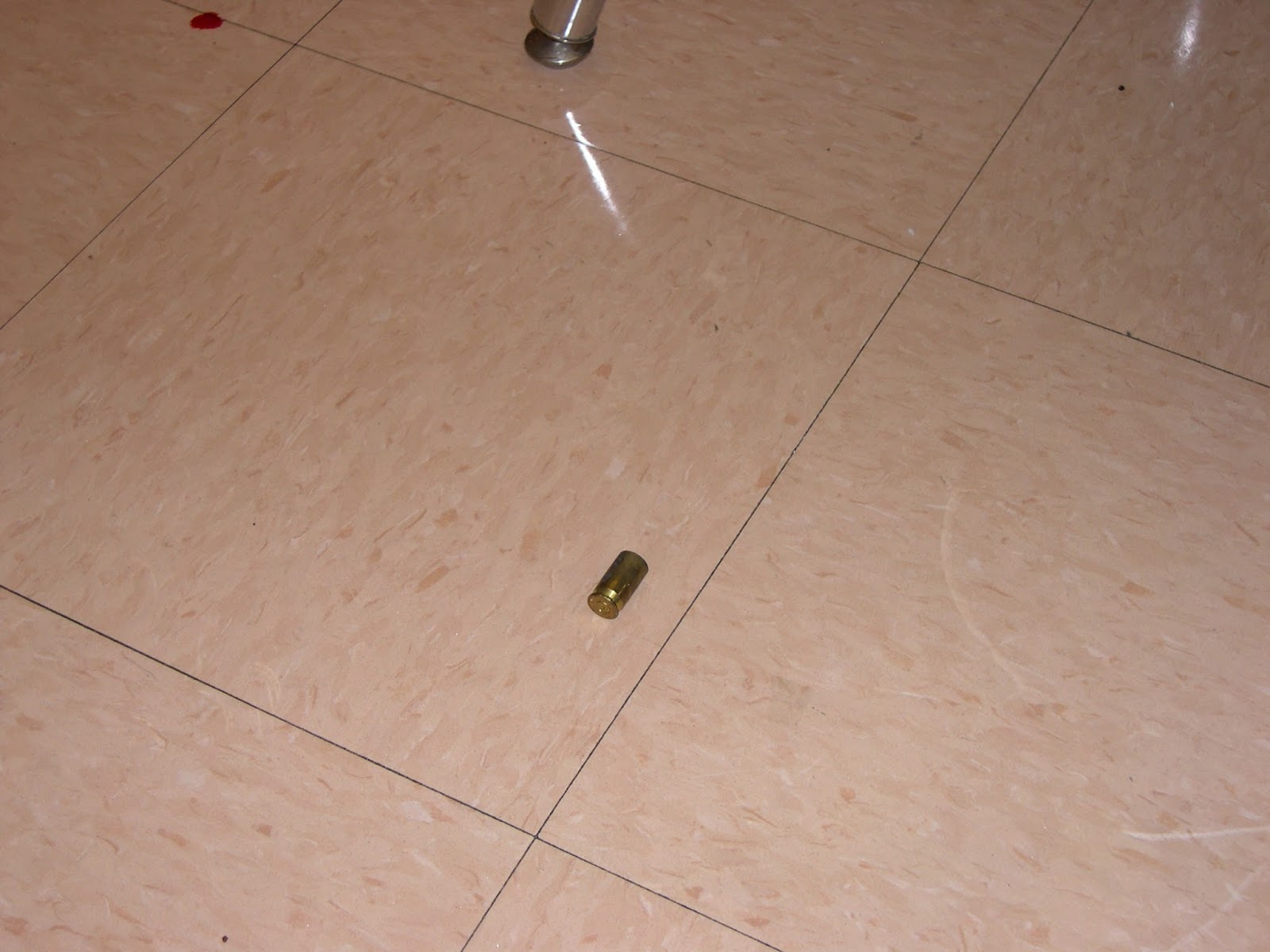
Bullet casing.

Left side of table where the homicide victim was found seated.

Right side of table where the homicide victim was found seated.

Spent projectile on window sill behind homicide victim.

Robert catalogs the physical evidence on the table, while Daniel is entering his data into the digital forms.

Jack was given the task of measuring the positions of all the physical evidence. Daniel is assigning item numbers to the evidence, writing descriptions and deciding on what the disposition of the evidence should be once it arrives in the lab.

Jack and Robert examine the ledge behind the homicide victim

Sophia and Jack examine the evidence on the table before the homicide victim.