Thursday, January 23, 2014

Summer Programs

We have recently received information on two summer programs available to students interested in pursuing the study of science over the summer months.
 
http://www.summerscience.org/home/index.php
http://www.seas.upenn.edu/saast/

Thursday, December 26, 2013

Forensic Glass Analysis

     On the last day of classes before the Holiday Recess, students in the Forensic Science class completed their Forensic Glass Analysis labs. Their written lab reports will be due at the end of week when they return to classes.

     In the first lab the students, examined sheet glass, lead crystal glass, tempered glass and borosilicate glass samples visually distinguishing between the samples and measuring the densities of the different glass types. They also shattered sheet glass to study fracture patterns. They examined the broken edges to learn how a forensic scientist can determine which side of the glass was impacted to cause the fractures. At the end of this lab the students examined six glass samples related to two hypothetical crime scenarios.

      In the second lab pictured here, the students were introduced to a new scenario which will involve the students, as the year proceeds, in using the analytical skills learned to process the different types of evidence. At the end of the year, the students will present all of the data they analyzed in a mock trial once they have solved the scenario.

     The glass evidence they were analyzing came from glass found at an accident site in which three bodies were found in a burned vehicle found off a mountainside road and an abandoned vehicle found far from the accident and thought to be driven from the accident scene by a person of interest. The students were using Becke lines, produced by the refraction of light, to identify and compare the different glass samples. They were give three different liquids (each with unique refractive indices) to be used to determine the refractive indices of the different glass samples. They had two reference samples (bottle glass and headlight glass)to compare to the two crime scene samples (glass from the vehicle crash site and glass from the abandoned vehicle).
Katie prepares slides of the various glass samples in the liquids for her forensics team to exam with their microscope.
Kylie and Kailey are labeling the slides their team member Katie had prepared before the examine them under the microscope .
Nick watches as his partner, Alex, examines one of the samples their team prepared to determine the position of the Becke line.
Patrick examines his team's sample while team members Emma a Joanna log the teams data for the different samples.
Katie examines her team's data while Vivian logs their data while Kristen avoids the camera by hiding behind her "let it snow" pillow.

Sunday, December 1, 2013

DNA and Human Trafficking

Krissy Marrinan
Forensics
December 1st 2013
Current Events

DNA and Human Trafficking
Chris Asplen

            In this article, Chris Asplen talks about DNA and how it has benefited the criminal justice system. Asplen explains how DNA is used to solve cold cases and help the Innocence Project; a project where they release wrongfully convicted people. He also goes into detail how human trafficking has gotten worse and that the process has become similar to that of booking a trip to “Disneyland”.  Asplen explains that having DNA as a resource will help put a stop to trafficking because it gives the victims, a little encouragement and safety, to use their voice to stand up against their abusers. By supporting the victims, police have the chance to start to understand the patterns of the traffickers and possibly identify some of the criminals. Asplen hopes that somehow DNA will put and end to human trafficking and all injustice that has previously happened.
            The information in this article really opened my eyes to the possibility that human trafficking could come to screeching halt if DNA could play a role in capturing the horrible criminals. “At a profit margin of $32 billion a year, second in magnitude only to trafficking of illegal drugs, as many as 27 million men, women, and children are victims of modern slavery”. From this quote, it is clear that human trafficking is a real problem, and somehow needs to stop. Young teenage girls are the target for human trafficking and this effect many of us, because we all know someone who is a young teen, and realizing that someone her age is going through this is horrifying.

            Though I agree with much of what Chris Asplen is writing, I though some of the points that he was making were not connected to what I originally thought the article was going to be about, so it mislead me a little bit.  But overall I really thought that Asplen made a compelling argument to why DNA could really put a dent in human trafficking.

http://www.forensicmag.com/articles/2013/08/dna-and-human-trafficking#.UptWD6Wn3wI

Asplen, Chris. "Forensic Magazine." Forensic Magazine., 28 Aug. 2013. Web. 01 Dec. 2013.

Tuesday, November 26, 2013

Crime Scene Presentations

The Forensic class was divided into six teams, each of which was comprised of four students. Each team had one class period to record and sketch the crime scene that was set up in the classroom. In the past, each student had to complete a formal lab report which included a rough and final sketch of the crime scene. This year, once the students had gathered their data and photographed their crime scene evidence, they were asked to produce a presentation of their findings. As you can see each team took a slightly different approach in how they presented the information that they had gathered. The class will spend the remainder of the year examining some of the protocols that could be used to examine/verify/test the evidence found at a crime scene.
Video of Student Presentations


Wednesday, October 23, 2013

Forensic Anthropology

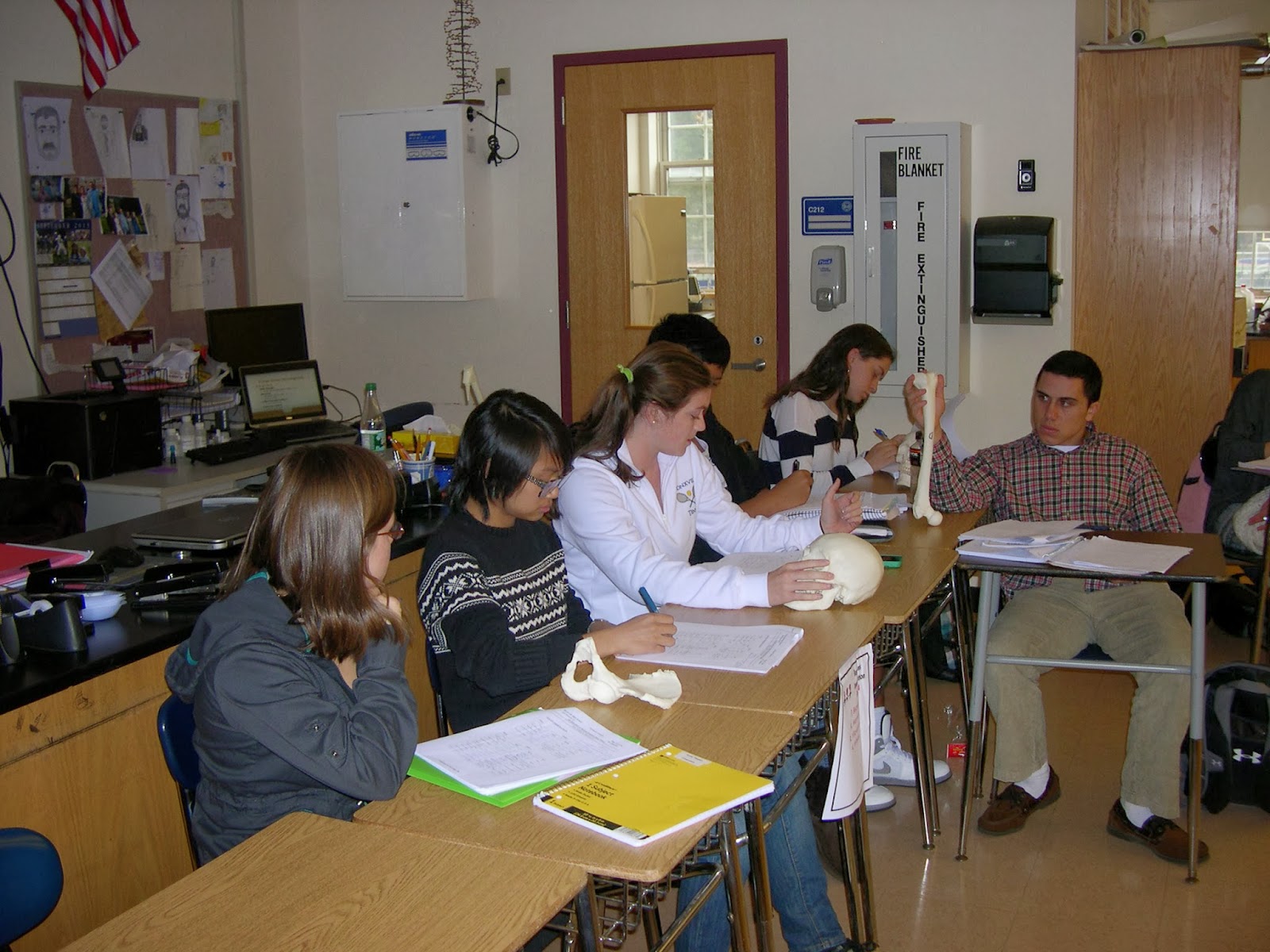
Forensic anthropologists identify individuals involved in crimes of cataclysmic accidents, when the only remains available are bones. By examining the skull and long bones, noting their characteristics and taking careful measurements, the sex, age, phenotype (race) and stature of the individual can be determines/estimated.

A previous posting to this blog covered the students in their groups as they were taking their measurements and making their observations.

In this activity teams of four students were give skeletal pieces (a skull, a leg bone, an arm bone, and a pelvis girdle), their task to identify the sex, race, stature and age of their individual. Each team then reported out their findings in class today, and all teams explained their findings expertly!. Great job ladies and gentlemen.

All the students will write up individual lab reports including each group's findings in their final report.
Claire and James listen as Abby presents her finding based on her observations of the long bones from her skeleton.

Claire explains how she used geological evidence and an acid assay to verify the location of the ancient burial site from which their skeleton was recovered.

Jaems describes his findings based on the examination of the skull from his group's skeleton as Liam, Jesse and Joanna look on and take notes on James' finding.

James and Liam refer to their notes on the skeleton examined by their group.

Liam reviews his notes on the observations and his conclusions he could make from his examination of the humerus (upper arm bone) from his groups skeleton.

Matthew describes his groups find based on observations of the skull from his group's skeleton. James on his right was responsible for examining the skeleton's femur.

Katie discusses her finding by pointing out the pertinent characteristic's of her skeleton's skull, while Patrick gets ready to present his finding based on the femur he examined.

Katie explains her conclusiond based on her examination and measurements of the pelvic girdle in front of her on the desk.

Kristen describes the characteristics of her findings regarding the skull from the skeleton exumed from the burial site verified by Claire earlier. Kailey prepares to explain her conclusions from the examination of the partial pelvic girdle from the same skeleton.

Add caption

Vivian explains how she examined the dental arch before her to determine the phenotype (race) of the individual.